
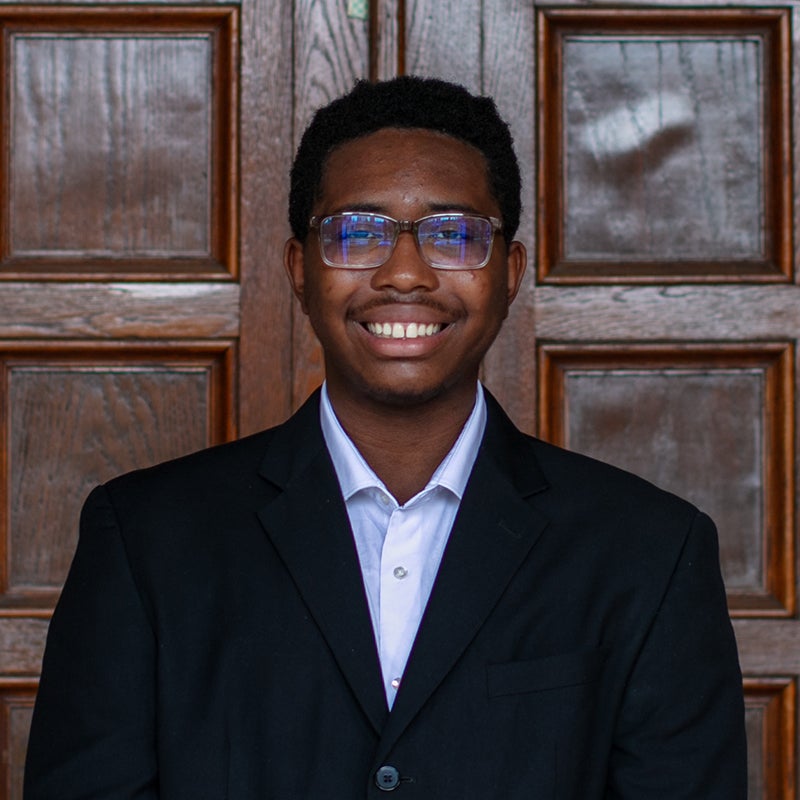
Q: What initially drew you to study sociology at Rice?
A: My interest in understanding how society constructs systems and hierarchies that shape our lives is what initially drew me to study Sociology. From High School through my Intro to Sociology Course (SOCI 101), I developed an interest in critical readings on race, class, and gender; particularly through the work of scholars such as Patricia Hill Collins and Cahrisse Burden Stelley. Through my assignments and class discussions, I also became interested in asking broader philosophical questions around knowledge and ontology. I saw sociology as a way to connect these abstract theories to not only my own life, but also the lives of others.
Q: What do you value most about your experience in the sociology program?
A: What I value most would be the diversity of conversations within the program and the connection between ideas discussed in the classroom to issues that affect people’s everyday lives. The sociology program has allowed me to take courses exploring race, education, healthcare, and law and how institutions affect social groups in different ways. Understanding these connections was eye-opening and allowed me to look beyond individual circumstances and recognize the larger social conditions that contribute to a population’s experiences.
Q: What skills or ways of thinking have you already developed through studying sociology?
A: Studying sociology has taught me to take concepts from sociological theorists and use them to make sense of common phenomena I encounter in everyday life. For example, I have used Marx's concept of alienation and Weber's idea of rationalization to examine how certain holidays and festivals, while rooted in social and cultural traditions, can become increasingly focused on consumption and profit. Generally, I have learned to question why certain things are organized the way they are, who benefits from them, and how those arrangements influence people's behavior.
Q: Is there something you have learned at Rice Sociology that you believe will set you apart and give you an “edge” when you enter the workforce?
A: Sociology has given me the ability to look beyond surface level problems and understand how organizations and institutions operate. For example, if an organization is struggling with employee retention or unequal outcomes, I have learned to look beyond individual performance and consider how its policies, workplace culture, and internal structures might be contributing to the problem. This perspective is valuable in many fields such as consulting, law, public policy, and even medicine/healthcare because it helps identify problems that might otherwise go unnoticed and consider how decisions affect different groups of people. I believe understanding workplace dynamics and their broader implications will set me apart in the workforce and give me an edge when developing thoughtful and effective solutions.
Q: What do you think a sociology education gives students that they might not get elsewhere?
A: A sociology education is unique because it teaches students to question things that are often taken for granted or viewed as the result of individual choices. One concept I find particularly valuable is denaturalization, which involves examining how social norms and institutions are shaped by history, culture, and power. For example, when I study legal concepts, my sociology experiences help me look beyond whether a policy appears neutral and consider whether it produces unequal outcomes for different groups. This ability to question assumptions and recognize underlying inequalities is something I think sets sociology apart.
Q: What are some unique opportunities you’ve had as a Rice sociology student in the School of Social Sciences?
A: One of the most impactful opportunities I have had was participating in the Community Health Practicum, which allowed me to connect sociological concepts with experiences outside the classroom. I also had the opportunity to conduct an observational research project for The Future of Work (SOCI 319), where I studied how technology shapes service work and the organization of labor at Buc-ee's. Through visits to two locations in Texas, I examined how employees, customers, and technologies interact, particularly how automation can shift responsibilities rather than simply replace workers. Additionally, my work as a Community Health and Legal Intern with Houston reVision allowed me to examine the legal and social implications of youth incarceration while helping connect justice involved youth with legal and social resources.
Q: What piece of advice would you give a Rice student considering majoring in sociology?
A: My biggest piece of advice would be to seriously consider majoring in sociology because it offers a unique and widely applicable way to understand the world and the people around us. One of the things I have appreciated most about the major is how it connects seemingly different subjects, from law and education to healthcare, economics, and technology, through a broader understanding of society. That versatility makes sociology valuable across many fields because it teaches you to understand people, recognize social and institutional dynamics, and think critically about complex problems. I would encourage students to remain curious, explore different courses, and be willing to question assumptions they may have previously taken for granted. If you enjoy asking why society operates the way it does and want to develop skills you can apply in a variety of academic and professional settings, I think sociology is a really rewarding major to pursue.